How Many Calories Per Person Per Day to Plan for Emergency Food Storage
This post may contain affiliate links, full disclosure here.
Quick answer: most households plan emergency food at about 2,000 calories per adult per day, then adjust using the Dietary Guidelines for Americans, which estimate roughly 1,600 to 2,400 calories a day for adult women and 2,000 to 3,000 for adult men depending on age and activity. Young children need about 1,000 to 1,400 calories, and active teens can need as much as adults. Multiply each person’s daily figure by the days you want to cover, add a margin for cold weather, heavy physical work, pregnancy or breastfeeding, then read Nutrition Facts labels to see how many calories your pantry actually holds.
A pantry can look full and still fall short. Shelves of broth, canned vegetables and diet snacks take up space without delivering much energy, while a few bags of rice and jars of peanut butter quietly hold days of food. Counting calories is the simplest way to know how long your supply would really last.
This article is part of our emergency food storage guide, which covers what to store, containers, rotation and cooking without power. Here the focus is narrower: how many calories each person in your household needs, how to total them for a 3-day, 2-week or 3-month plan, and which foods make the math easy.
Sources: Dietary Guidelines for Americans, 2020-2025 (U.S. Department of Agriculture and U.S. Department of Health and Human Services), Appendix 2, Estimated Calorie Needs, and life-stage chapters on pregnancy and lactation; American Red Cross, emergency supply recommendations; Ready.gov, Food; USDA FoodData Central for typical nutrient values. Calorie figures for specific foods vary by brand; check the Nutrition Facts label on what you buy. General information, not medical or nutrition advice. Checked October 2026.

Why Plan in Calories Instead of Meals or Cans
Counting cans or “days of meals” sounds simpler, yet the numbers drift badly. One can of chili might be a full meal for a child and a snack for a teenager. A “30-day bucket” from one seller may hold far fewer calories per day than another seller’s.
Calories give you a common unit. Once you know your household’s daily total, every item in the pantry converts into days of food. That makes gaps obvious and shopping more targeted.
Calories are not the whole story, of course. A pantry of nothing but white rice and sugar would hit the numbers and still leave people short on protein, vitamins and fiber. Treat calories as the first check and nutrition as the second.

Daily Calorie Needs by Age and Activity
The Dietary Guidelines for Americans, 2020-2025, publish estimated calorie needs by age, sex and three activity levels: sedentary, moderately active and active. Our table below rounds those estimates into planning ranges. The low end reflects a sedentary person; the high end reflects an active one.
| Age group | Females (calories per day) | Males (calories per day) |
|---|---|---|
| 2 to 3 years | About 1,000 to 1,400 | About 1,000 to 1,400 |
| 4 to 8 years | About 1,200 to 1,800 | About 1,200 to 2,000 |
| 9 to 13 years | About 1,400 to 2,200 | About 1,600 to 2,600 |
| 14 to 18 years | About 1,800 to 2,400 | About 2,000 to 3,200 |
| 19 to 30 years | About 1,800 to 2,400 | About 2,400 to 3,000 |
| 31 to 59 years | About 1,600 to 2,200 | About 2,200 to 3,000 |
| 60 and older | About 1,600 to 2,000 | About 2,000 to 2,600 |
These figures are estimates, as the guidelines stress. Height, weight, health conditions and actual activity all move the number. For planning, though, they are more than precise enough.
Infants under 2 are a special case. Babies need breast milk or infant formula and, later, age-appropriate foods, not a share of the adult pantry. Plan those supplies separately with guidance from your pediatrician.

Choosing a Planning Number for Your Household
A common shortcut is 2,000 calories per adult per day. That figure matches the reference value used on Nutrition Facts labels and sits in the middle of the adult ranges. It is a reasonable default for households that are not especially active.
Adjust upward when any of these apply:
- Physical work during the emergency. Clearing debris, hauling water, climbing stairs in a building with no elevator and cleaning up after a flood burn far more energy than a normal day at a desk.
- Cold conditions. People in a home without heat use extra energy staying warm.
- Teenagers. Active teen boys can need over 3,000 calories, per the guidelines.
- Pregnancy and breastfeeding. The Dietary Guidelines note that calorie needs rise in the second and third trimesters and during lactation, by a few hundred calories a day.
Adjust downward for young children and for older, less active adults. Rather than averaging everyone, list each person with a daily figure. It takes two minutes and makes the totals much more accurate.

Worked Examples: Totaling a 3-Day, 2-Week and 3-Month Supply
The American Red Cross recommends a 3-day supply of food for evacuation and a 2-week supply for home. Here is how the math works for three sample households, using mid-range daily figures.
| Household | Daily total | 3 days | 14 days | 90 days |
|---|---|---|---|---|
| One adult (2,000) | 2,000 | 6,000 | 28,000 | 180,000 |
| Two adults (2,000 + 2,400) | 4,400 | 13,200 | 61,600 | 396,000 |
| Two adults and two kids, ages 5 and 12 (2,000 + 2,400 + 1,400 + 2,000) | 7,800 | 23,400 | 109,200 | 702,000 |
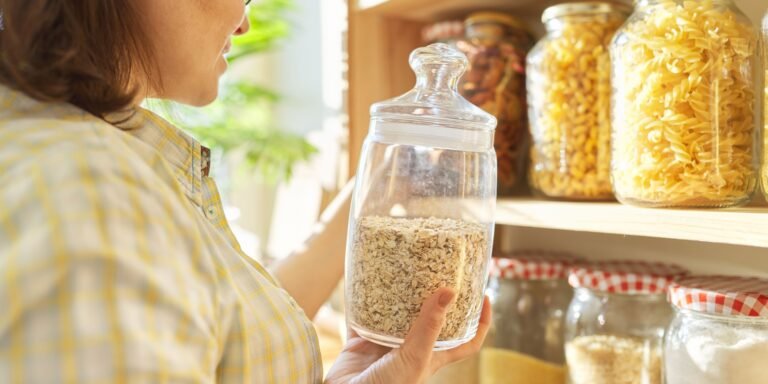
Those totals look intimidating until you compare them with food labels. A family needing about 109,000 calories for two weeks could reach the target with a mix of staples like the ones below, plus canned proteins, fruits and vegetables for nutrition.
For the 3-day evacuation layer, calories per pound matters too, because someone has to carry it. Our earlier 72-hour apartment blackout and pantry checklist lists compact, ready-to-eat options.

Calorie-Dense Staples and How They Add Up
Calorie density varies enormously across foods. The values below are typical of Nutrition Facts panels and USDA FoodData Central entries; check your own labels, since brands differ.
| Food | Typical calories | Notes |
|---|---|---|
| White rice, dry | About 1,600 per pound | Needs water and heat |
| Rolled oats, dry | About 1,700 per pound | Can be soaked instead of cooked |
| Dry pasta | About 1,600 per pound | Needs water and heat |
| Dried beans or lentils | About 1,500 per pound | Long cooking time for beans; lentils are faster |
| Peanut butter | About 2,600 per pound | Ready to eat, good protein and fat |
| Vegetable oil | About 120 per tablespoon | Adds calories to any meal |
| Canned beans | About 300 to 400 per 15-ounce can | Ready to eat |
| Canned tuna or chicken | About 100 to 250 per can | Protein-focused, lower calorie |
| Canned vegetables | Often under 150 per can | Valuable for nutrients, not calories |
The pattern is clear. Dry grains, legumes, nut butters and oils carry most of the calories. Canned vegetables, fruit and broth carry nutrients, flavor and water. A balanced pantry needs both.
Water is the hidden constraint. Rice, pasta, oats and beans all need water to prepare. Ready.gov recommends storing at least one gallon of water per person per day, and cooking adds to that. If water is tight, shift the balance toward ready-to-eat foods.

Covering Nutrition, Not Just Calories
Once the calorie total is in place, check the pantry against the basic food groups the Dietary Guidelines describe.
Protein. Canned beans, lentils, canned fish and chicken, peanut butter, nuts and shelf-stable milk all contribute. Protein helps people feel full and matters for children and older adults.
Fruits and vegetables. Canned, dried and freeze-dried versions provide vitamins and fiber. Canned fruit packed in juice and low-sodium vegetables are easier on thirst.
Grains. Rice, oats, pasta, crackers and cereal provide most of the energy. Whole grains add fiber, though brown rice and whole wheat flour have shorter shelf lives than white versions.
Dairy or alternatives. Shelf-stable boxed milk, powdered milk and fortified plant milks fill this group.
Fats. Cooking oil, nuts and nut butters are dense in energy and make bland staples more palatable.
Ready.gov suggests choosing foods your family will eat and avoiding very salty items. A pantry that people enjoy eating is also one that rotates, which keeps it fresh.

Turning Your Calorie Target Into a Shopping List
A target number is only useful when it becomes a plan. Here is a straightforward process:
- List each person with a daily calorie figure from the table above.
- Total the household’s daily calories and multiply by the number of days for each stage.
- Inventory what you already have. Read labels and add up calories per item. A spreadsheet with columns for item, quantity, calories per unit and total calories works well.
- Fill the calorie gap with staples like rice, oats, beans, pasta and peanut butter, which cost the least per calorie.
- Fill the nutrition gaps with canned proteins, fruits and vegetables.
- Add comfort foods like coffee, tea, cocoa and familiar snacks.
- Recalculate when the household changes, such as a new baby, a growing teen or a new medical diet.
Our older article on how much food to stock for emergencies offers more item-level ideas, and the guide to building a two-week emergency food supply turns the 14-day number into a menu.

Calories on the Move: Go-Bags and Evacuation
The 3-day evacuation supply has a different job from the home pantry. It must be light, compact, ready to eat and able to survive months in a closet or car trunk. That changes the math in two ways.
First, weight matters as much as calories. A backpack full of canned soup is heavy and delivers little energy. Foods with high calories per ounce, such as nut butter packets, trail mix, granola, dried fruit, hard crackers and ration bars, carry far more energy for the same weight. Many people pack roughly the same daily calorie figure they use at home and accept that variety will be limited for a few days.
Second, cooking is unlikely. Assume no stove, no clean dishes and limited water. Pull-tab cans, pouches and bars work; dry rice and beans do not.
Heat is the enemy of go-bag food. Vehicles and closets on exterior walls get hot, which shortens shelf life and can make bars and nut butters go rancid. Check and rotate go-bag food at least twice a year, and replace anything that looks or smells off.

Common Calorie Planning Mistakes
- Counting cans instead of calories. Ten cans of green beans are not ten meals.
- Planning for “average” people. Teens and physically active adults eat far more than the average.
- Forgetting the water needed to cook staples. Dry foods only help if you can prepare them.
- Relying on survival bars alone. They are useful in go-bags, but few people want to eat them for two weeks.
- Ignoring special diets. Medical, allergy and infant needs require their own supplies.
- Never recalculating. Children grow, and households change.

Frequently Asked Questions
How many calories should I store per person per day for emergencies?
A common planning figure is 2,000 calories per adult per day. The Dietary Guidelines for Americans estimate about 1,600 to 2,400 for adult women and 2,000 to 3,000 for adult men, depending on age and activity.
How many calories do children need in emergency food planning?
According to the Dietary Guidelines, children ages 2 to 3 need about 1,000 to 1,400 calories a day, ages 4 to 8 about 1,200 to 2,000, and older children and teens progressively more, with active teen boys reaching over 3,000.
How many calories are in a two-week emergency food supply for one adult?
At 2,000 calories a day, one adult needs about 28,000 calories for 14 days. A more active adult at 2,400 calories a day needs about 33,600.
What foods give the most calories for emergency storage?
Oils, nut butters, dry grains like rice and oats, pasta and dried beans are among the most calorie-dense and affordable staples. Check Nutrition Facts labels for exact values.
Can people survive on fewer calories during an emergency?
People can go short for a few days, but cutting calories lowers energy and concentration when you may need both. Plan for normal needs, and talk to a doctor about any medical diet.

The Bottom Line
Calorie planning turns emergency food storage from guesswork into simple math. Give each person a daily figure from the Dietary Guidelines ranges, multiply by the days you want to cover and compare the total against your labels. Fill the gap with affordable staples, then round out protein, fruits and vegetables. With that number in hand, every shopping trip moves the pantry toward a supply that will actually last as long as you think it will.