Generator Safety: Carbon Monoxide, Placement and Fuel Storage
This post may contain affiliate links, full disclosure here.
Quick answer: run a portable generator only outdoors, at least 20 feet from your home with the exhaust pointed away from windows, doors and vents, as the Consumer Product Safety Commission advises. Never run one in a garage, basement, shed or crawlspace, even with the door open. Install battery-powered or battery-backup carbon monoxide alarms on every level of the home and outside sleeping areas. Plug appliances in with heavy-duty, outdoor-rated extension cords or use a transfer switch installed by a licensed electrician, never a wall outlet. Shut the generator off and let it cool before refueling, and store fuel in approved containers away from the living space.
Portable generators keep refrigerators cold, sump pumps running and phones charged when the grid goes down. They also cause serious injuries and deaths every year, most of them from carbon monoxide. Nearly all of those incidents trace back to a few avoidable mistakes.
This guide explains the main hazards and the safety rules from the agencies that study them: the Consumer Product Safety Commission, the CDC, Ready.gov, OSHA and the American Red Cross. It is part of our emergency power guide, which covers choosing and sizing backup power.

Why Carbon Monoxide Is the Biggest Danger
Carbon monoxide is a gas produced whenever fuel burns. It has no color, no smell and no taste. Gasoline, propane and diesel engines all produce it, and a portable generator produces a great deal of it in a short time.
The CDC explains that breathing carbon monoxide prevents the blood from carrying oxygen to the body’s organs. Symptoms are often described as flu-like: headache, dizziness, weakness, upset stomach, vomiting, chest pain and confusion. People who are asleep or have been drinking alcohol can be poisoned and die before they notice any symptoms. Everyone in a home can be affected at once, including pets.
Opening doors and windows does not make indoor use safe. CPSC warns that carbon monoxide can build up to dangerous levels in enclosed and partly enclosed spaces, even with ventilation, and can linger for hours after the generator is turned off.
What to do if you suspect poisoning
If a carbon monoxide alarm sounds or anyone feels sick, dizzy or weak while a generator is running, get everyone to fresh air right away. Call 911 from outside. Do not go back in until emergency responders say it is safe.

Placement: The 20-Foot Rule and Beyond
Generator placement matters more than any other decision.
CPSC’s guidance is to operate portable generators outside only, at least 20 feet from the house, with the engine exhaust directed away from windows, doors and vents. That means never inside:
- A home, including basements and crawlspaces
- An attached or detached garage, even with the door open
- A shed, carport enclosure or covered porch with walls
- A tent or camper
A few more placement habits help:
- Keep the exhaust pointed away from your home and your neighbors’ homes, since fumes can drift into nearby windows and air intakes
- Avoid placing the generator near air conditioning units, fresh-air vents or crawlspace openings
- Set it on a level, dry surface where it cannot tip
- Keep children and pets away from the running unit, since engine parts get very hot
Our explainer on how a portable generator’s exhaust temperature feature works covers another reason to keep the area around the engine clear.
Carbon monoxide shutoff features
Many newer portable generators include a carbon monoxide sensing shutoff that stops the engine if carbon monoxide builds up around the unit, and some engines are designed to emit less carbon monoxide. These features are found on models certified to voluntary safety standards such as UL 2201 and ANSI/PGMA G300. They add protection but do not change the rules. A generator with a shutoff still belongs outdoors, far from openings.

Carbon Monoxide Alarms
Carbon monoxide detectors, usually sold as CO alarms, are the backup that catches mistakes and drifting fumes. CPSC recommends installing carbon monoxide alarms on each level of the home and outside separate sleeping areas. During an outage, plug-in and hardwired alarms need battery backup to keep working, so check that the backup batteries are fresh before storm season.
Look for alarms that meet the UL 2034 safety standard, and test them monthly, as CPSC recommends. Interconnected alarms are best, since when one sounds they all sound. Replace alarms when they reach the end-of-life date printed on the unit or when they chirp to signal end of life.
Smoke alarms matter too. Outages bring more candles, lanterns and alternative heat sources, all of which raise fire risk. The American Red Cross recommends flashlights over candles for light.

Electrical Safety: Cords, Grounding and Transfer Switches
Never backfeed
Plugging a generator into a wall outlet, sometimes with a homemade double-male cord, is called backfeeding. Ready.gov, CPSC and OSHA all warn against it. Electricity can flow backward through the home’s wiring and out onto the utility grid, where it can electrocute power line workers and neighbors served by the same transformer. It can also damage the generator and start a fire when grid power returns.
The safe way to connect a generator to home circuits is through a transfer switch or an approved interlock installed by a licensed electrician. The switch isolates the house from the utility while the generator is running.
How a transfer switch, interlock and generator inlet work
A typical safe setup has three parts. A generator inlet, sometimes called a power inlet box, is a weatherproof outlet mounted on the outside wall where a heavy-duty generator cord plugs in. Inside, a transfer switch or an interlock kit on the electrical panel controls which source feeds the house. An interlock is a mechanical plate that makes it impossible to turn on the generator breaker while the main breaker is on, so the house is always disconnected from the utility before generator power flows in. A transfer switch does the same job with its own switches for selected circuits.
With either setup, the routine is the same: turn off the main breaker or set the switch to generator, start the generator outdoors, plug it into the inlet, then turn on circuits one at a time. Reverse the steps when grid power returns. These electrical connections must be installed by a licensed electrician, usually with a permit, because a wiring mistake can create the same backfeed hazard the equipment is meant to prevent.
Extension cords
For plugging appliances in directly, OSHA and the Red Cross recommend heavy-duty, outdoor-rated extension cords with a grounded three-prong plug. Practical checks:
- Make sure the cord’s rating, in watts or amps, is at least equal to the total load of everything plugged into it
- Inspect cords for cuts, worn insulation and damaged plugs before use
- Run cords where they will not be pinched by doors or driven over
- Do not run cords under rugs or carpets, where heat can build up unnoticed
- Keep connections off wet ground
Grounding and overload
Follow the manufacturer’s instructions on grounding, since requirements depend on the generator’s design and how it is connected. OSHA explains that a portable generator’s frame can serve as the ground when it powers only cord-and-plug equipment through its own outlets and the equipment is bonded to the frame. A ground rod or other grounding electrode may be needed in other setups, and a generator that feeds a home’s wiring through a transfer switch must be grounded according to the electrical code. Ask your electrician which applies to your installation. Do not plug in more than the generator can handle. Overloading can damage the generator and connected appliances, and the generator’s outlets and circuit breakers are there to protect against it.

Wet Weather
Storms and generators go together, which makes water a constant concern. Ready.gov advises keeping generators dry and not using them in wet conditions. CPSC suggests operating them on a dry surface under an open, canopy-like structure that keeps rain off without trapping exhaust.
Weatherproof enclosures, generator tents and covers made for running units are sold for this purpose; choose ones designed to allow airflow and exhaust to escape, and still observe the 20-foot distance. A homemade box or a tarp wrapped around the generator can trap heat and exhaust, creating both a fire hazard and a carbon monoxide hazard. Dry your hands before touching a generator, and do not stand in water while operating one.
Fire Hazards and Fuel Leaks
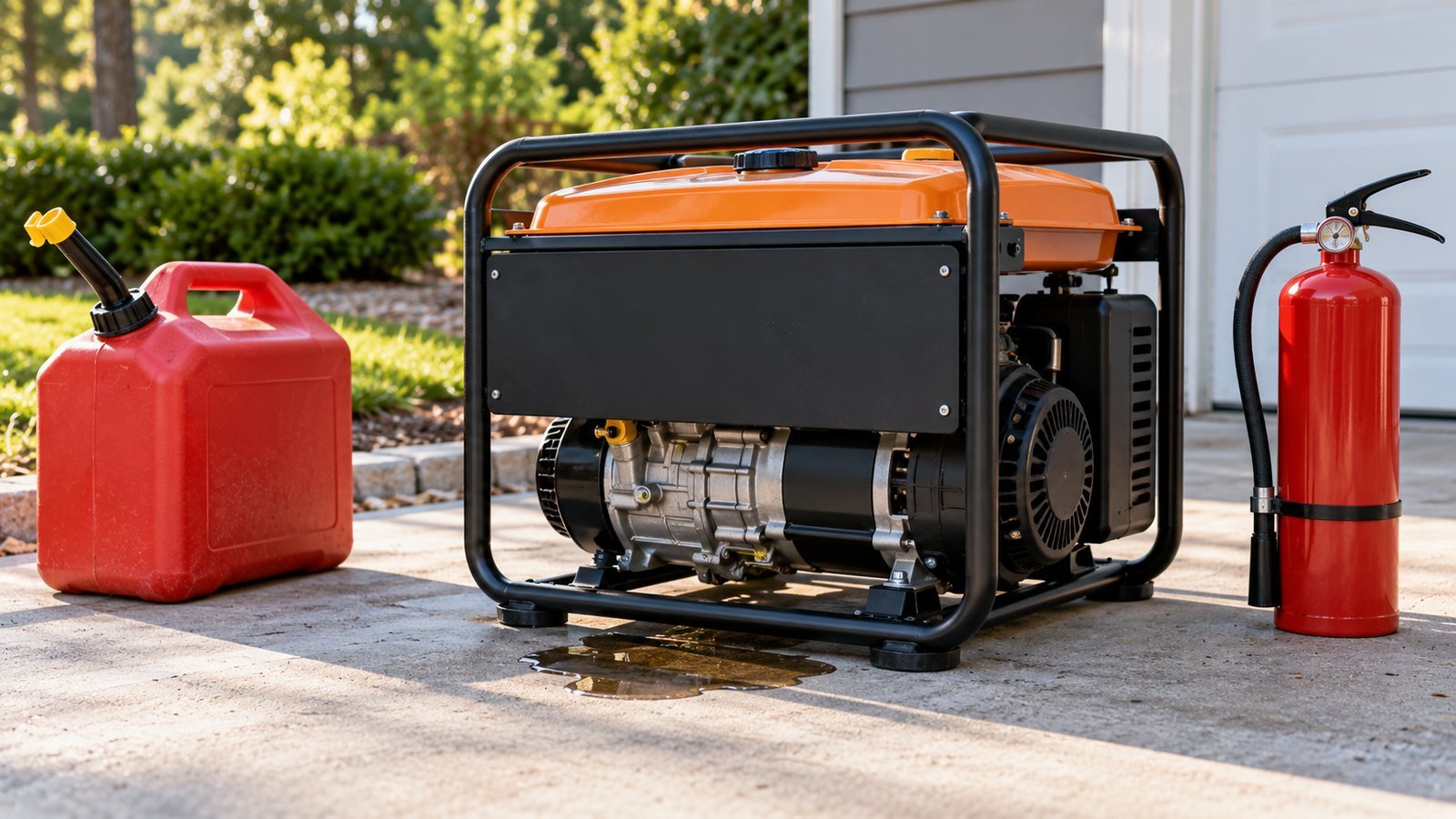
Carbon monoxide gets most of the attention, but a running generator is also a fire hazard. The engine and muffler get hot enough to ignite dry grass, leaves, paper or fabric, and gasoline vapor can ignite from a spark or a hot surface.
Keep a clear zone
Follow the clearances in your manual, and keep the area around the generator free of anything that can burn: leaf piles, firewood, cardboard, tarps and stored fuel. Do not run a generator under a deck, against a fence or beside a woodpile. A dry, level, non-flammable surface, such as concrete or gravel, is the best base.
Check for fuel leaks
Before each start, look and sniff for fuel leaks around the tank, fuel lines, fuel valve and carburetor. A gasoline smell, wet spots or drips mean the generator should not be started until the problem is fixed. Fuel lines on generators that sit for months can crack, and a leak onto a hot engine can start a fire. Our guide on starting a generator that has been sitting covers what to inspect.
Overloaded cords and connections
Undersized or damaged extension cords can overheat and start fires. Match the cord rating to the load, keep connections dry and off the ground, and feel cords occasionally during use. A warm cord is overloaded or damaged and should be unplugged.

Refueling Safely
Fuel spilled on a hot engine can ignite. OSHA and CPSC both advise turning the generator off and letting it cool before refueling. Additional precautions:
- Refuel outdoors in daylight if possible, with a flashlight rather than an open flame after dark
- Use a funnel or a container with a spout designed to limit spills
- Wipe up spills and let vapors clear before restarting
- Do not smoke near the generator or fuel
- Keep a fire extinguisher rated for flammable liquids nearby
Plan refueling into the outage routine. Many owners schedule it during the day so they are not handling gasoline in the dark.

Storing Fuel Safely
Gasoline is one of the most dangerous items in a typical home. Ready.gov and OSHA recommend storing fuel only in approved fuel containers, outside the living area, in a cool, ventilated place away from any fuel-burning appliance. CPSC adds that gas cans should never be stored inside a house or basement or near pilot lights, stoves, heaters or other ignition sources. Good fuel storage is mostly about distance and ventilation. A gasoline can in an attached garage next to a water heater or furnace pilot light is a fire waiting to happen.
Guidelines that apply to most households:
- Use containers made and labeled for the fuel you store
- Keep containers tightly closed and out of direct sunlight
- Store fuel away from heat sources, sparks and electrical equipment
- Keep quantities modest; local fire codes often limit how much can be stored at a residence
- Label containers with the date filled and rotate the supply
- Keep fuel out of reach of children
Buying and filling fuel containers
CPSC now requires flame mitigation devices on new gas cans and other portable fuel containers, under a mandatory safety standard that took effect July 12, 2023. The devices help stop a flame from flashing back into the container. Choose a child-resistant can of five gallons or less made for the fuel you use. When filling, CPSC advises always placing the gas can on the ground at the pump. A NIOSH hazard notice explains why: cans filled in a truck bed with a plastic liner or on vehicle carpet can build up static electricity that ignites gasoline vapor.
Gasoline also degrades over time. Fuel stabilizer, used as directed, helps it last longer, and running stored fuel through a car and replacing it keeps the supply fresh. Our guide to storing gasoline long term covers containers, stabilizers and rotation in more depth.
Propane cylinders should be stored outdoors, upright, away from the house and never in a basement or garage, following the supplier’s guidance. Our comparison of propane and gas generators explains the fuel trade-offs.

Maintenance and Pre-Storm Checks
A generator that fails to start in the middle of a storm tempts people into rushed, unsafe fixes. Regular maintenance prevents that.
Before each storm season:
- Read the manual again, especially the safety section.
- Change the oil if due and check the air filter and spark plug.
- Start the generator and run it under a light load for the time the manual suggests.
- Check extension cords, the transfer switch and the generator cover.
- Test carbon monoxide and smoke alarms and replace backup batteries.
- Confirm your outdoor operating spot is at least 20 feet from every door, window and vent.
- Check your fuel supply and stabilizer.
Our guide on starting a generator that has been sitting walks through bringing an idle unit back to life.

Renters, Condos and Close Neighbors
Generator safety gets harder where homes are close together. Townhouses, duplexes and small city lots may not have any spot 20 feet from every door, window and vent, including the neighbors’ openings. In that situation, a fuel generator may simply not be a safe option, and a battery-based power station is the better choice for essentials.
Apartment and condo rules usually ban generators on balconies, patios and in parking garages, and for good reason. Exhaust from a balcony can enter the unit above, and a garage traps fumes that spread into stairwells and hallways. If a neighbor is running a generator in an unsafe spot, a polite word can prevent a tragedy; if carbon monoxide alarms sound in a shared building, leave and call 911.
A one-page safety card
Many households tape a short card to the generator or keep it in the storm kit, so anyone who runs it follows the same rules:
- Outdoors only, 20 feet or more from all doors, windows and vents
- Exhaust pointed away from every building
- Carbon monoxide alarms tested and working
- Cords outdoor-rated and undamaged; never plugged into a wall outlet
- Off and cool before refueling
- Fuel stored in approved cans, away from the house

Other Fuel-Burning Equipment
The same carbon monoxide rules apply to other equipment people turn to during outages. The CDC and Ready.gov warn never to use a charcoal or gas grill, camp stove or any gasoline, propane, natural gas or charcoal-burning device inside a home, garage, basement or partly enclosed area. Never use a gas range or oven to heat a home, and never run a car in an attached garage, even with the door open.

Frequently Asked Questions
How far away from the house should a generator be?
The Consumer Product Safety Commission recommends at least 20 feet, with the exhaust pointed away from windows, doors and vents.
Can I run a generator in my garage with the door open?
No. Carbon monoxide can build to deadly levels in a garage even with the door open and can seep into the house.
Can I run a generator in the rain?
Keep it dry. Operate it on a dry surface under an open, canopy-like structure or a cover designed for running generators, and never under a closed structure that traps exhaust.
Do I need a transfer switch for a generator?
To power home circuits, yes. A transfer switch or approved interlock installed by a licensed electrician prevents dangerous backfeeding. Without one, plug appliances directly into the generator with outdoor-rated cords.
What are the signs of carbon monoxide poisoning?
The CDC lists headache, dizziness, weakness, upset stomach, vomiting, chest pain and confusion. If anyone has these symptoms or an alarm sounds, get to fresh air and call 911.
What is a generator interlock?
An interlock is a mechanical device on the electrical panel that prevents the main breaker and the generator breaker from being on at the same time. It keeps generator power from backfeeding onto the utility grid. It should be installed by a licensed electrician along with a generator inlet.
Do I need a ground rod for my portable generator?
Not always. OSHA explains that the generator’s frame can act as the ground when it powers only cord-and-plug equipment through its own outlets. Other setups, including some transfer switch connections, may require grounding to an electrode. Follow the manual and ask an electrician.
Where should I store gas cans for my generator?
Outdoors or in a detached, ventilated shed, away from the house, pilot lights and other ignition sources, in approved, tightly closed fuel containers. Never store them in the home or basement.
Sources: U.S. Consumer Product Safety Commission (Portable Generator Safety; Carbon Monoxide Safety Center), CDC (Carbon Monoxide Poisoning Prevention), Ready.gov (Generators; Power Outages), OSHA (Portable Generator Safety), American Red Cross (Generator Safety; Power Outage Safety), UL Standards and Engagement (UL 2034, UL 2201); OSHA fact sheet, Grounding Requirements for Portable Generators; CPSC, Fuel Container, Gasoline and Other Liquid Fuel Safety (flame mitigation standard effective July 12, 2023); NIOSH, Fire Hazard from Filling Portable Gas Cans in Pickup Trucks and Cars. Follow your generator’s manual and local fire codes.