Wildfire Smoke in an Apartment: How to Keep Indoor Air Cleaner When the AQI Spikes
This post may contain affiliate links, full disclosure here.
Quick answer: when wildfire smoke drifts into your city, check the Air Quality Index on AirNow.gov, close windows and doors, run a portable HEPA air cleaner sized for your room (or a DIY box fan filter with a MERV 13 filter) and create one clean room to spend most of your time in. Avoid adding indoor pollution from frying, candles or smoking. Wear a well-fitted NIOSH-approved N95 respirator outdoors when the air is unhealthy, and never use an ozone generator.
Wildfire smoke can travel hundreds or even thousands of miles. In June 2023, smoke from fires in Canada pushed air quality in New York City to some of the worst levels recorded in the world at the time, and residents across the Northeast and Midwest dealt with orange skies for days. Apartment dwellers face particular challenges: older windows, shared ventilation, limited space for equipment and little control over the building’s air system.
This guide explains how to keep indoor air cleaner during smoke events. It is part of our apartment emergency kit guide, and the supplies here fit easily into a small home.
Sources: U.S. Environmental Protection Agency, Wildfire Smoke: A Guide for Public Health Officials (2019, updated 2021), Air Cleaners and Air Filters in the Home, Ozone Generators That Are Sold as Air Cleaners, and Research on DIY Air Cleaners; AirNow.gov, Air Quality Index basics; Centers for Disease Control and Prevention, Wildfire Smoke and Protecting Yourself from Wildfire Smoke; Association of Home Appliance Manufacturers, Clean Air Delivery Rate guidance; NYC Emergency Management. Checked October 2026.
Why Wildfire Smoke Is Harmful
Wildfire smoke is a mix of gases and fine particles from burning trees, plants, buildings and other materials. The biggest health concern is fine particulate matter, called PM2.5, made of particles 2.5 micrometers or smaller. According to the EPA, these particles can travel deep into the lungs and may enter the bloodstream.
Short-term exposure can cause:
- Coughing, scratchy throat and irritated sinuses
- Burning eyes and runny nose
- Headaches and fatigue
- Shortness of breath and chest tightness
- Worsening of asthma, COPD and heart disease
The CDC notes that some groups are at higher risk, including people with heart or lung disease, older adults, children, pregnant people and outdoor workers.
The health effects of particulate matter go beyond short-term irritation. The EPA links exposure to particle pollution with aggravated asthma, decreased lung function, irregular heartbeat and nonfatal heart attacks, and with premature death in people with heart or lung disease. Most healthy people recover once the smoke clears, but repeated smoke days are a reason to protect indoor air quality for everyone at home.
Check the Air Quality Index
The Air Quality Index (AQI), published at AirNow.gov and in many weather apps, shows how polluted the air is and what it means for health.
| AQI | Category | What it means |
|---|---|---|
| 0 to 50 | Good | Air quality is satisfactory |
| 51 to 100 | Moderate | Unusually sensitive people may be affected |
| 101 to 150 | Unhealthy for Sensitive Groups | Sensitive groups may experience effects |
| 151 to 200 | Unhealthy | Everyone may begin to experience effects |
| 201 to 300 | Very Unhealthy | Health alert: increased risk for everyone |
| 301 and higher | Hazardous | Emergency conditions |
AirNow also includes a Fire and Smoke Map that combines official monitors with data from low-cost sensors, giving a more local picture. Sign up for alerts through your city or state emergency notification system so you know when smoke is coming.

Step 1: Seal Out Smoke
The first goal is keeping smoky outdoor air from getting inside.
- Close all windows and doors. Lock windows to pull the sash tight against the seals.
- Use painter’s tape or weatherstripping to cover gaps around window air conditioners, older windows and the door to the hallway.
- Place a rolled towel at the base of the front door if hallway air smells smoky.
- Close fireplace dampers if you have one.
- Turn off or set bathroom and kitchen exhaust fans to run only briefly, since they pull in outside air through gaps.
Our guide to sheltering in place covers sealing a room in more detail.
Step 2: Manage Air Conditioners and HVAC
Many apartments have window units, through-wall units, mini splits or central systems.
- Window and through-wall air conditioners: set them to recirculate if there is a setting, and close the outside air vent or damper. Clean or replace the filter.
- Central HVAC with an in-unit air handler: run the fan in recirculate mode, and upgrade to the highest-rated filter the system can handle. The EPA suggests MERV 13 or higher when possible. Check with building management before changing filters.
- Building-wide systems: ask management whether the system can reduce outdoor air intake and use higher-efficiency filters during smoke events.
Staying cool matters too. If closing windows makes the apartment dangerously hot, see our guide to extreme heat safety. Heat can be a bigger immediate danger than smoke for some people, and a cleaner-air cooling center may be the best option.
HVAC Fan and Filter Settings
If you control an in-unit HVAC system, the EPA suggests setting the thermostat fan to On rather than Auto during smoke events, so air passes through the filter continuously instead of only when heating or cooling runs. Make sure the filter fits snugly with no gaps around the edges, since air that bypasses the filter is not cleaned, and close any fresh-air intake if your system has one.
Step 3: Clean the Air With a Portable Air Cleaner
A portable air cleaner with a true HEPA filter can greatly reduce indoor particle levels. The EPA recommends choosing one sized for the room where you spend the most time.
How to Size an Air Cleaner
Look for the Clean Air Delivery Rate (CADR) on the box. The Association of Home Appliance Manufacturers suggests a smoke CADR of at least two-thirds of the room’s floor area in square feet, assuming 8-foot ceilings.
| Room size | Minimum smoke CADR |
|---|---|
| 150 square feet | 100 |
| 250 square feet | 167 |
| 350 square feet | 233 |
| 450 square feet | 300 |
Larger is better during heavy smoke. Run the unit on its highest setting you can tolerate, and keep the door to that room closed.
Avoid These Devices
- Ozone generators: the EPA warns that ozone generators sold as air cleaners can produce ozone at levels that harm health and do not effectively remove particles.
- Ionizers and electrostatic precipitators may produce ozone as a byproduct. Look for units certified under California’s air cleaner regulations, which limit ozone emissions.
Step 4: DIY Box Fan Filter
If you cannot buy or find a portable air cleaner, a do-it-yourself box fan filter can help. EPA research has found that a box fan with a MERV 13 filter attached can reduce indoor PM2.5. A common version, sometimes called a Corsi-Rosenthal box, uses four filters taped into a cube with a box fan on top.
Basic single-filter version:
- Choose a 20-inch box fan, preferably a newer model.
- Attach a 20-by-20-inch MERV 13 filter to the back (intake side) with tape or straps, with the airflow arrow pointing toward the fan.
- Run it in the room where you spend the most time.
- Replace the filter when it looks dark or dirty.
Use the fan according to the manufacturer’s safety instructions, keep it away from water and turn it off when no one is home. Newer fans with built-in safety features are a better choice than very old models.

Step 5: Create a Clean Room
Instead of trying to clean the air in the whole apartment, focus on one room, usually the bedroom.
- Pick a room with as few windows and exterior doors as possible.
- Seal the windows.
- Run the air cleaner or DIY filter continuously.
- Keep the door closed.
- Spend as much time as possible there, especially while sleeping.
Step 6: Avoid Adding Indoor Pollution
During smoke events, the CDC and EPA advise reducing indoor sources of particles:
- Avoid frying or broiling food; use the microwave or cold meals instead.
- Do not burn candles, incense or use gas stoves more than necessary.
- Avoid smoking indoors.
- Skip vacuuming unless your vacuum has a HEPA filter, since it stirs up dust.
- Avoid spraying aerosol cleaners and air fresheners.
Monitor Indoor Air Quality
An indoor air quality monitor with a PM2.5 sensor shows whether your efforts are working. Compare indoor readings with the outdoor AQI on AirNow: if indoor levels stay close to outdoor levels, look for leaks or add filtration. Low-cost sensors are less accurate than official monitors and can read high or low in smoke, which is why AirNow applies a correction to sensor data on its Fire and Smoke Map. Use a home monitor to spot trends, such as whether your clean room stays cleaner than the rest of the apartment, rather than as exact numbers.

Masks and Respirators
If you must go outside when the air is unhealthy, wear a well-fitted NIOSH-approved N95 or P100 respirator. The CDC notes that cloth masks, surgical masks and bandanas do not protect against the fine particles in wildfire smoke. Respirators work best when they fit snugly with no gaps around the edges; facial hair reduces the seal. Standard respirators are not designed for small children. Keep a few in your apartment emergency kit.

Protecting High-Risk Household Members
- People with asthma, COPD or heart disease should follow their action plans and have medications on hand. Talk with a doctor in advance about what to do during smoke events.
- Children breathe more air relative to their body size and spend more time active. Keep them indoors in the clean room when the AQI is high.
- Older adults may need help setting up air cleaners and checking on symptoms.
- Pets are affected by smoke too. Keep them indoors and limit walks to short bathroom breaks.

Watch for Symptoms
Seek medical care if you or someone you live with has trouble breathing, chest pain, a fast heartbeat or severe fatigue. Call 911 for emergencies. Keep in mind that in a building with power outages or broken elevators, getting help may take longer. Our guide to preparing for a power outage in a high-rise covers planning for those situations.
When to Leave for Cleaner Air
If your apartment cannot be kept cool and clean, look for cleaner-air spaces. Some cities open cleaner-air or cooling centers during smoke events, and libraries, malls and other public buildings with good filtration may offer relief. Staying with friends or family in an area with better air quality is another option. Check your city’s emergency management website for openings.

After the Smoke Clears
When the AQI drops back to good or moderate levels, a few steps help reset your apartment:
- Air out the apartment by opening windows once outdoor air is clean.
- Check and replace filters in air cleaners, DIY fans, window air conditioners and HVAC systems. Filters may darken quickly during heavy smoke.
- Wipe surfaces with a damp cloth to remove settled ash and dust, rather than dry dusting.
- Wash bedding and curtains if they smell of smoke.
- Restock supplies such as N95 respirators and spare filters so you are ready for the next event.
- Note what worked. Write down which room stayed cleanest, how long filters lasted and what you wished you had, then update your kit.
When cleaning up ash, CDC guidance is to avoid stirring it back into the air: wipe hard surfaces with a damp cloth, mop rather than dry sweep and use a vacuum with a HEPA filter. Wear an N95 respirator and gloves if there is visible ash, since it can irritate the skin and lungs. Whether you rent an apartment or own a house, report lingering odor or smoke damage, such as residue on walls or soot around vents, in writing; heavy smoke damage may need professional cleaning.

Talking to Your Landlord or Building
Renters often cannot change ventilation systems on their own. Before smoke season, it helps to ask building management a few questions:
- Does the building’s ventilation system have filters, and can they be upgraded during smoke events?
- Can outdoor air intake be reduced when air quality is poor?
- Are window seals and weatherstripping in good repair?
- Will the building share alerts or open a common room with filtered air?
Put requests in writing and keep a copy. Tenants’ associations can also raise these issues together.
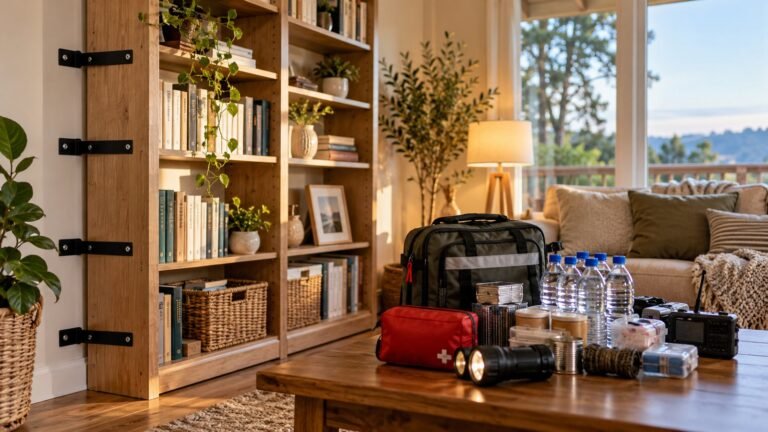
Smoke Supplies for Your Apartment Kit
- Portable HEPA air cleaner sized for your bedroom, plus a spare filter
- Box fan and MERV 13 filters for a DIY option
- NIOSH-approved N95 respirators for each adult
- Painter’s tape and weatherstripping
- Towels for door gaps
- Medications and inhalers for at-risk household members
- Shelf-stable foods that need no cooking, like those on our 72-hour apartment emergency pantry checklist
Frequently Asked Questions
Do air purifiers help with wildfire smoke?
Yes. Portable air cleaners with true HEPA filters, sized for the room, can greatly reduce indoor fine particles during smoke events, according to the EPA.
Should I open windows during wildfire smoke?
Generally no. Keep windows and doors closed when outdoor air is smoky, unless the apartment becomes dangerously hot. In that case, seek a cleaner-air or cooling space.
Do surgical masks protect against wildfire smoke?
No. The CDC says cloth and surgical masks do not protect against fine smoke particles. Use a well-fitted NIOSH-approved N95 or P100 respirator.
What AQI is unsafe for wildfire smoke?
An AQI over 100 is unhealthy for sensitive groups, and over 150 is unhealthy for everyone. Limit time outdoors as the number rises.
Can I make my own air purifier?
Yes. A box fan with a MERV 13 filter attached can reduce indoor particles, according to EPA research. Turn it off when no one is home.

The Bottom Line
Wildfire smoke is no longer just a Western problem; it can reach cities across the country. In an apartment, the most effective steps are to close up, clean the air in one room with a properly sized HEPA air cleaner or DIY box fan filter, avoid adding indoor pollution and wear an N95 outdoors when the AQI is unhealthy. A few inexpensive supplies stored ahead of time make a smoky week much easier to handle.