Pet Emergency Plan for Apartment Dwellers: Kits, Carriers, Buddy Systems and Evacuation
This post may contain affiliate links, full disclosure here.
Quick answer: Ready.gov’s rule is simple: if you are told to evacuate, your pet evacuates too. For apartment dwellers that means a pet carrier for each animal kept within reach, a lightweight grab kit (several days of food and water, medications, leash, ID and records) plus a larger shelter-in-place kit, a microchip with current contact details, a buddy in the building who can get your pet out if you are not home, and a list of pet-friendly places to stay, since many public shelters and hotels do not allow pets inside. Practice getting your pet into its carrier before you ever need to.
Pets complicate emergencies everywhere, but especially in apartments. Getting a frightened cat out from under a bed and down 10 flights of stairs, or carrying a large dog past smoke, takes planning that most people never do until it is too late.
This guide adapts guidance from Ready.gov and animal welfare organizations to life in a city apartment. It is part of our apartment emergency kit guide, which covers the supplies people need.
Sources: Ready.gov, Prepare Your Pets for Disasters; FEMA, Pets Evacuation and Transportation Standards (PETS) Act of 2006 summary; American Society for the Prevention of Cruelty to Animals (ASPCA), Disaster Preparedness and pet rescue alert sticker guidance; U.S. Fire Administration, high-rise fire safety guidance. General information; follow instructions from local officials and your veterinarian. Checked October 2026.

Why Pets Need Their Own Plan
Ready.gov explains that having a plan reduces difficulty, stress and worry when decisions must be made fast. If local officials ask you to evacuate, Ready.gov says your pet should evacuate too, because pets left behind may end up lost, injured or worse.
In a city, the most likely emergencies are often a building fire, a prolonged power outage, a water main break, flooding in low-lying neighborhoods or a severe storm. Some of these mean leaving within minutes. Others mean staying put for days without elevators or utilities. A good pet plan covers both.

Step 1: Make Sure Your Pet Can Be Identified
Ready.gov recommends microchipping pets and keeping your address and phone number up to date with the microchip registry, including an emergency contact outside your immediate area. Pets also should wear a collar with a current ID tag.
Add these steps:
- Keep a backup collar, leash and ID tag in your kit, as Ready.gov suggests.
- Store copies of registration, vaccination and medical records in a waterproof container and electronically.
- Keep a current photo of you with your pet. Ready.gov notes this helps prove ownership and helps others identify your pet if you are separated.

Step 2: Build Two Pet Kits
Ready.gov recommends two kits: a larger one for sheltering in place and a lightweight version for evacuating. In an apartment with limited storage, the grab kit can live next to the carrier near the door, and the bigger kit can share a closet with your own supplies.
| Item | Grab kit | Shelter-in-place kit |
|---|---|---|
| Food in an airtight, waterproof container | Several days | A larger supply |
| Water and a bowl | Several days | A larger supply |
| Medications in a waterproof container | Extra supply | Extra supply |
| Pet first aid kit (ask your vet what to include) | Yes | Yes |
| Collar, ID tag, harness or leash plus backups | Yes | Yes |
| Records and photo of you with your pet | Copies | Originals or copies |
| Litter, litter box or pads, bags, paper towels | Small supply | Larger supply |
| Familiar toys, treats or bedding | One or two | Yes |
| Grooming items | Optional | Yes |
Ready.gov also suggests household chlorine bleach for sanitation in a longer emergency. Review kits regularly to keep food and medicines fresh. For how much water to plan for animals, see our guide to emergency water for pets and babies.

Step 3: Get a Carrier for Each Pet and Train With It
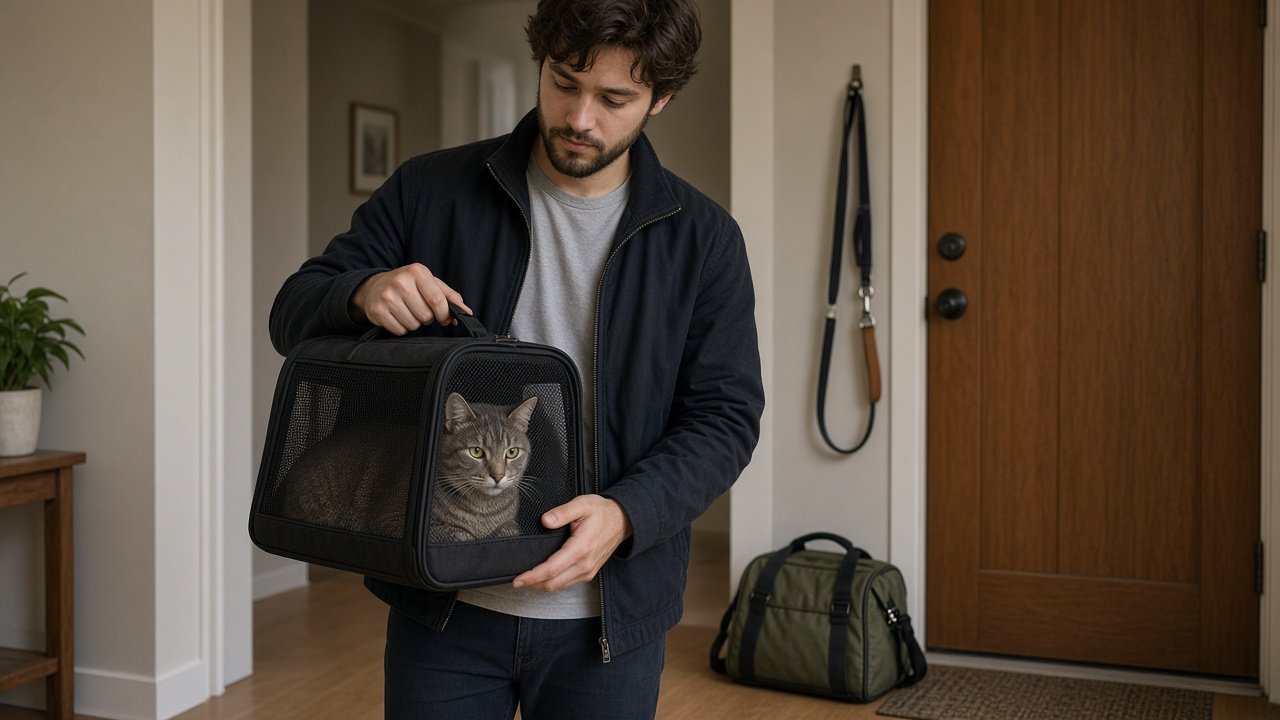
In an apartment evacuation, a carrier is not optional for cats and small animals. Ready.gov recommends a sturdy carrier, crate or travel bag, ideally one for each pet.
The hard part is getting your pet inside quickly. Ready.gov’s tips for making carriers familiar include:
- Leave the carrier out in places your pet visits often.
- Keep it open.
- Feed treats near and inside it.
- Put a familiar blanket or bed inside so it smells like home.
- Note where your pets hide, so you can find them quickly.
For dogs too large to carry, practice walking down your building’s stairwell on a leash. Elevators may not be available in an emergency, and stairwells can be loud and crowded during an evacuation. A dog that has walked those stairs calmly before is easier to move when it counts.

Step 4: Set Up a Buddy System in Your Building
You may not be home when something happens. Ready.gov recommends a buddy system with neighbors, friends or relatives who can care for or evacuate your pets if you cannot.
In an apartment building, the best buddy is a neighbor on your floor or a nearby floor who:
- Has a key or knows how to reach building staff for access.
- Knows where your pets hide and where the carrier and kit are kept.
- Has your phone number and your vet’s number.
- Agrees on where to take your pets if they need to leave.
Offer to do the same for them. Write down the arrangement and include it in your emergency communication plan.

Step 5: Let Responders Know a Pet Is Inside
The ASPCA recommends a rescue alert sticker on a front door or window to let rescue workers know pets are inside, with the number and type of pets and your vet’s contact. If you evacuate with your pets and have time, the ASPCA suggests writing “EVACUATED” across the sticker so responders do not spend time searching.
Check your lease and building rules before placing anything on a door, and tell building management or the front desk that you have pets. Some buildings keep a list for firefighters.

Step 6: Know Where Your Pet Can Go
Ready.gov warns that many public shelters and hotels do not allow pets inside. Planning ahead can save hours in an evacuation:
- Ask friends or relatives outside your neighborhood whether they could host you and your pets.
- Make a list of pet-friendly hotels in nearby areas.
- Ask your vet and local boarding facilities about emergency boarding.
- Contact your local emergency management office or animal shelter about pet-friendly shelters.
Since the PETS Act of 2006, FEMA has required state and local emergency plans that receive federal funding to account for household pets and service animals. That has expanded pet-friendly sheltering in many areas, but arrangements vary, so check what your city offers before you need it.

Step 7: Plan for Sheltering in Place With Pets
Many city emergencies, such as blackouts, heat waves and winter storms, mean staying home. Our guide to sheltering in place covers the general steps. For pets, add:
- Bathroom plans. If you cannot go outside, dogs may need pee pads or a designated spot on a balcony. Keep extra litter for cats.
- Temperature control. During a summer outage, keep pets in the coolest room and provide plenty of water. In winter, keep them in the warmest room with bedding.
- Food safety. Use dry food first if wet food requires refrigeration.
- Stress management. Familiar bedding, toys and a quiet room help anxious animals.

Step 8: Plan for a Building Fire
Fire is the emergency most likely to force a fast exit from an apartment. The U.S. Fire Administration advises using the stairs, not elevators, and closing doors behind you. With pets:
- Grab the carrier and leash only if you can do it immediately. Do not delay your own escape to search for a hiding pet.
- Never go back inside a burning building for a pet. Tell firefighters your pet is inside and where it usually hides.
- Keep leashes and carriers by the door so grabbing them takes seconds.
Our apartment fire safety plan covers exit routes and when to stay in your unit.

Getting Around Without a Car
Many city residents do not own a car, which changes how an evacuation with pets works. Plan your transportation before you need it:
- Public transit. Check your local transit agency’s pet rules. Many systems allow small pets only in closed carriers, and rules for larger dogs vary widely. During an official evacuation, special transit arrangements may differ, so follow local announcements.
- Rideshare and taxis. Under the Americans with Disabilities Act, service animals must generally be accommodated. Pets are a different matter and are often at the driver’s discretion, though some rideshare apps offer pet-friendly ride options in certain cities.
- Friends with cars. Arrange in advance with someone who could pick you and your pets up, and agree on a meeting point if roads near your building are closed.
- Walking routes. Know how you would walk your dog to a friend’s place or a shelter if transit stops.

Make a Pet Care Card
If someone else ends up caring for your pet, even for a day, they will need information fast. Write a one-page card and keep copies in each kit and on your phone:
- Pet’s name, species, breed, age, color and microchip number.
- Feeding amounts and schedule.
- Medications, doses and timing.
- Behavior notes, such as fear of other dogs or a tendency to bolt.
- Your vet’s name, address and phone number, plus an emergency vet.
- Your contact information and an out-of-area contact.

Pets With Special Needs
Senior pets, animals with chronic conditions and exotic pets need extra planning:
- Ask your vet how much medication to keep on hand and how to store it if refrigeration is lost.
- Keep printed instructions for medication and feeding in the kit, in case a buddy or boarding facility cares for your pet.
- For birds, reptiles and small mammals, plan for heat or light sources, cages that fit in a car and species-appropriate food.

Practice and Review
Run a short drill once or twice a year. Time how long it takes to find your pet, load the carrier, grab the kit and reach the stairwell. If it takes more than a few minutes, look for the bottleneck. Often it is a pet hiding in a spot you cannot reach, a carrier stored in the back of a closet or a kit missing its leash. Fix one problem per drill. Update microchip details when you move or change phone numbers, and refresh food and medication in your kits.

Frequently Asked Questions

Frequently Asked Questions
Should I take my pet if I evacuate? Yes. Ready.gov says that if officials ask you to evacuate, your pet should evacuate too. Pets left behind may be lost or injured.
What should be in a pet emergency kit? Several days of food and water, medications, a first aid kit, a collar with ID plus backups, a leash or harness, a carrier, records, a photo of you with your pet, sanitation supplies and familiar items.
Do emergency shelters accept pets? Some do. Many public shelters and hotels do not allow pets inside, so research pet-friendly shelters, hotels, boarding and friends' homes ahead of time.
How do I get my cat into a carrier quickly? Practice ahead. Leave the carrier out and open, feed treats inside it and add familiar bedding. Know where your cat hides.
What is a pet rescue alert sticker? A sticker on a door or window, recommended by the ASPCA, that tells responders how many and what kind of pets are inside.
What if I am not home during an emergency? Set up a buddy system with a neighbor who can access your apartment, knows where your pets and supplies are, and knows where to take them.

The Bottom Line
A pet emergency plan for apartment life comes down to a few concrete things: ID and a microchip, two kits, a carrier your pet tolerates, a neighbor who can step in and a list of places you can go together. Put them in place now, practice once or twice a year, and an emergency is far less likely to separate you from your pet.