Solar Generators Explained: Panels, Batteries and Realistic Run Times
This post may contain affiliate links, full disclosure here.
Quick answer: a “solar generator” is a portable power station paired with solar panels. The battery stores energy and the panels recharge it in daylight. To estimate what it can do, multiply the panel wattage by the peak sun hours for your location and season, then reduce the result to account for real-world losses. A 200-watt panel set might add several hundred watt-hours on a clear day and far less on a cloudy winter one. Treat solar as a way to stretch a battery through a long outage, not as an unlimited supply.
Solar generators are marketed as silent, fuel-free backup power, and for the right job they deliver. They run indoors, make no exhaust and can recharge day after day without a trip to the gas station. They also have hard limits set by the size of the battery, the size of the panels and the weather.
This guide explains what is inside a solar generator, how to read panel ratings, how to estimate daily recharge and run time, and how to set one up safely. It is part of our emergency power guide, which compares solar with power stations, fuel generators and other options.
What a Solar Generator Actually Is
The term is a marketing label rather than a technical category. Nothing in the box generates electricity on its own. A typical solar generator kit includes:
- A portable power station: a lithium battery with a built-in inverter, outlets, USB ports and a charge controller
- One or more portable solar panels, often folding designs with kickstands
- Cables that connect the panels to the power station’s solar input
The photovoltaic cells in the panels convert sunlight into direct current (DC) electricity. A charge controller inside the power station regulates that current to charge the battery safely. Many units use maximum power point tracking, usually shortened to MPPT, which adjusts to get more energy from the panels as light conditions change. The inverter then turns stored energy into household alternating current (AC) for the outlets. Together, these parts let a solar generator turn solar power into battery storage you can use after dark.
Because the battery is the heart of the system, every limit of a power station applies. Capacity in watt-hours decides how long it runs a load. Inverter output in watts decides what it can run at once. Solar simply adds a way to refill the battery without a wall outlet.
DC and AC electricity, briefly
Solar panels and batteries both work in DC electricity. Most household plugs expect AC electricity, so the power station’s inverter converts DC to AC, losing some energy as heat along the way. When a device can run from a USB or 12-volt DC port instead of an AC outlet, it usually skips that conversion and gets a little more run time from the same battery capacity. Phones, LED lights, many routers with DC adapters and 12-volt camping fridges are common examples.
Inside the Battery: Lithium-Ion, LiFePO4 and Lead Acid
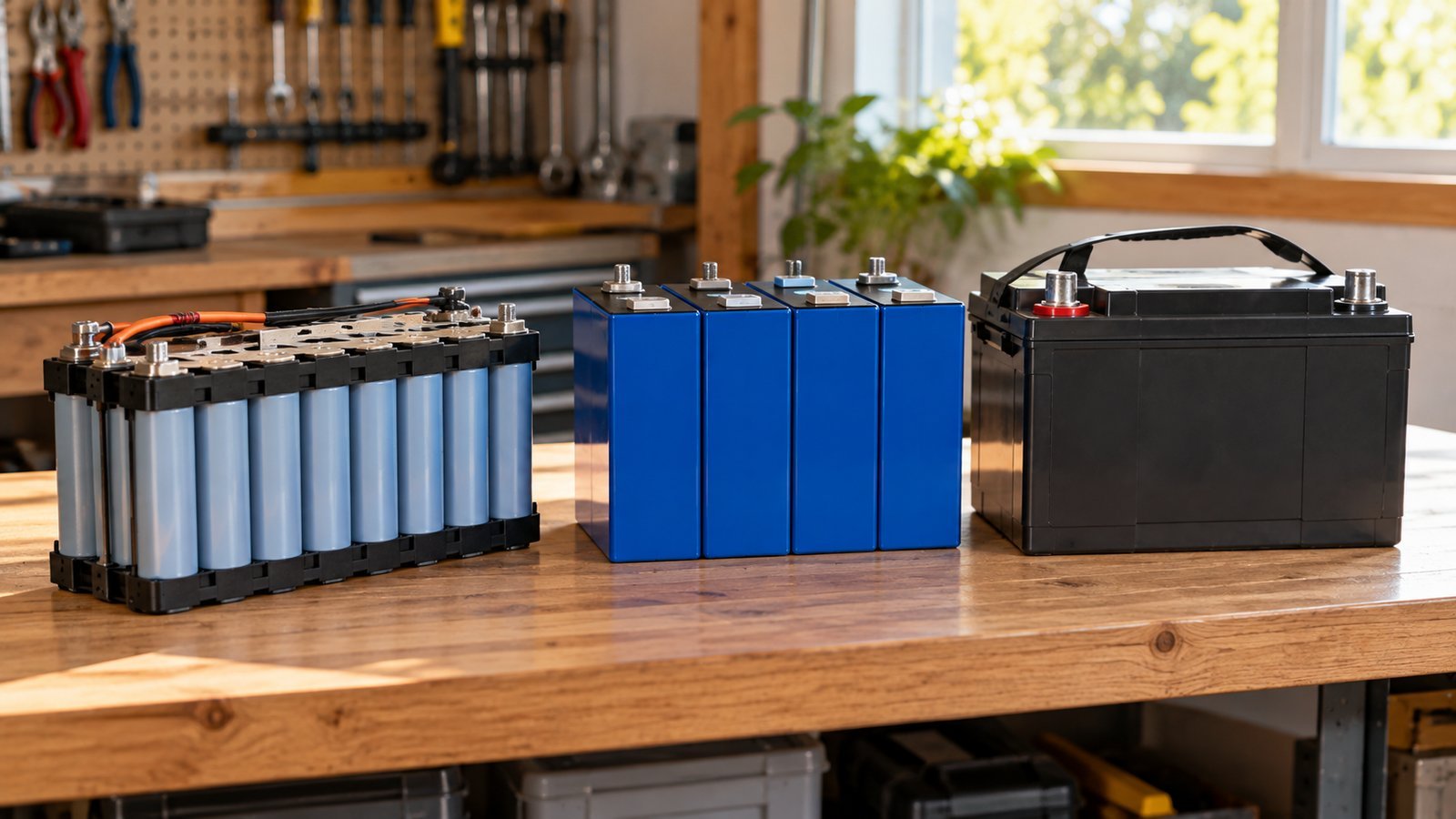
The battery decides how much a solar generator can store, how heavy it is and how many years it lasts. Three chemistries come up most often.
Lithium-ion (NMC and similar)
Many earlier and lighter power stations use lithium-ion cells with nickel-based chemistries such as NMC (nickel manganese cobalt). They pack more energy into less weight, which is why they suit smaller, portable units.
Lithium iron phosphate (LiFePO4)
Lithium iron phosphate, written LiFePO4 or LFP, is another lithium-ion chemistry and is now common in power stations and home battery storage. It is somewhat heavier for the same capacity but is generally regarded as more thermally stable. A 2020 Sandia National Laboratories study of commercial cells found that the LFP cells tested lasted roughly 2,500 to 9,000 full charge cycles before falling to 80 percent of their original capacity, compared with roughly 200 to 2,500 cycles for the NMC cells, with results that depended heavily on temperature and how deeply the cells were cycled. For a battery you may cycle every day in a long outage, that durability matters.
Lead acid
Lead acid batteries, the type in most cars, are still used in some older or do-it-yourself solar setups because they are inexpensive. They are much heavier for the same storage, and they are generally not meant to be drained deeply on a regular basis, so their usable capacity is lower than the label suggests. Flooded lead acid batteries can also release hydrogen gas while charging and need ventilation. For a portable solar generator in an apartment, lithium chemistries are the practical choice.
The battery management system
Every lithium power station includes a battery management system, or BMS. It monitors cell voltage, current and temperature, and it cuts off charging or discharging to protect the cells from overcharge, deep discharge, short circuits and extreme heat or cold. The BMS is why a power station may refuse to charge on a frozen balcony or shut off when a load is too large. Those limits are protection, not malfunctions.
How Solar Panel Ratings Work
Panels are sold by wattage, such as 100, 200 or 400 watts. That figure is measured under Standard Test Conditions, a laboratory benchmark that assumes strong sunlight of 1,000 watts per square meter hitting the panel at a cell temperature of 25 degrees Celsius. Real conditions rarely match.
Several factors cut output below the rating:
- Sun angle: panels produce the most when sunlight hits them straight on
- Time of day and season: morning, evening and winter light is weaker
- Clouds and haze: overcast skies can sharply reduce production
- Heat: solar cells become less efficient as they get hotter, so a scorching day is not always the best day
- Shade: even partial shade on part of a panel can cut output far more than the shaded area suggests
- Dust, pollen or snow on the surface
- Losses in cables and the charge controller
In practice, a portable panel rarely delivers its full rated wattage for long. Seeing it reach a large share of its rating for a few hours around midday in clear weather is common; seeing it hold that all day is not.

Peak Sun Hours and Daily Recharge
Peak sun hours are the easiest way to estimate daily solar energy. One peak sun hour equals an hour of sunlight at the 1,000 watts per square meter benchmark. A location that gets the equivalent of four such hours in a day has four peak sun hours, even though the sun was up much longer.
The National Laboratory of the Rockies, known as the National Renewable Energy Laboratory (NREL) until the Department of Energy renamed it in December 2025, publishes solar resource data for the United States, and its free PVWatts calculator estimates solar production for a given address, panel size and tilt. Those tools show how much peak sun hours vary by region and season. Southern and desert locations generally receive more than northern and cloudier ones, and winter values are lower almost everywhere.
A simple estimate
To estimate daily recharge:
- Take the total rated wattage of your panels.
- Multiply by the peak sun hours for your location and month.
- Multiply by a planning factor to account for real-world losses. Many people use something around 0.7 to 0.8 for portable setups, but your own results are the best guide.
For illustration, a hypothetical 200-watt panel set in a location with 4 peak sun hours, using a 0.75 planning factor, comes to about 600 watt-hours per day. The same setup with 2 peak sun hours on a short winter day would add about 300 watt-hours. Clouds or shade could cut either figure further.

Estimating Realistic Run Times
Run time depends on what you plug in and how much the panels add back.
Start with daily need. Add up the watt-hours your devices use in a day by multiplying each one’s watts by its hours of use. Compare that total with two numbers:
- The usable capacity of the battery, after inverter losses
- The expected daily solar recharge for your location and season
If daily solar recharge is larger than daily use, the system can, in theory, keep going indefinitely in clear weather. If use is larger, the battery drains a little each day and eventually runs out, with cloudy stretches speeding that up.
Example scenarios
Consider a hypothetical household load of phones, LED lights, a router and a small fan totaling about 400 watt-hours a day. A 1,000 watt-hour power station with the 200-watt panel set above could cover that load and recharge on sunny days, with the battery as a buffer for cloudy ones.
Add a refrigerator using more than 1,000 watt-hours a day, and the picture changes. The same panels could not keep up, and the battery would drain within a day or two. Running a refrigerator on solar alone usually takes much larger battery and panel capacity than a typical portable kit includes.
These examples use illustrative round numbers. Measure your own devices and check the specifications for any system you consider.
Reading a Solar Generator Spec Sheet
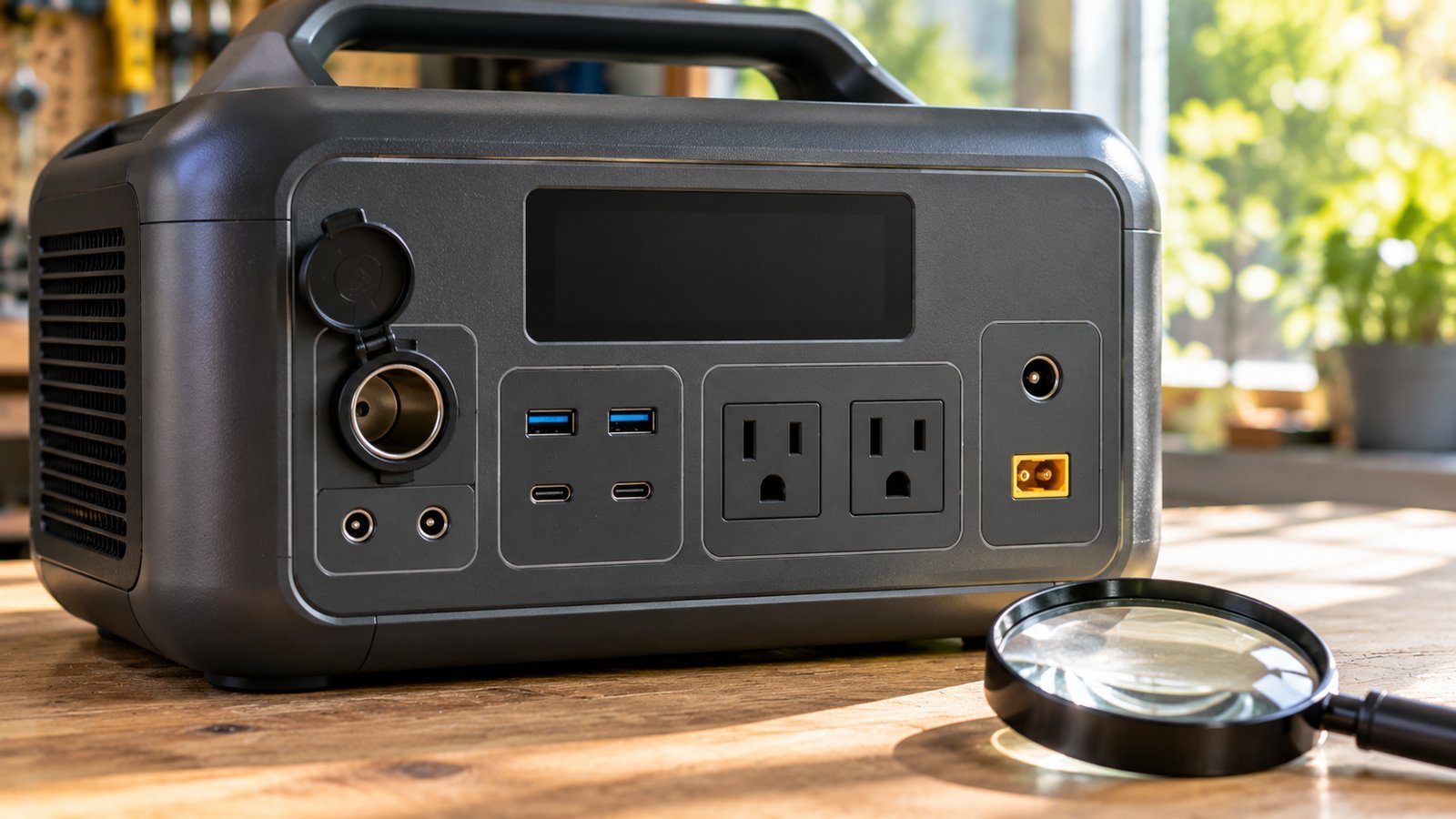
Product listings pack a lot of numbers into small print. This table explains the ones that matter most for outage planning.
| Spec | What it means | Why it matters |
|---|---|---|
| Battery capacity (Wh) | How much energy the battery stores | Sets run time for your daily load |
| Continuous power output (W) | The total load the inverter can supply at once | Decides what you can run together |
| Surge or peak power rating (W) | A short burst for motor start-up | Matters for refrigerators, pumps and some tools |
| Inverter type | Pure sine wave or modified sine wave | Pure sine wave output suits sensitive electronics and motors |
| Solar input (V and W) | Voltage range and maximum wattage from panels | Limits how fast panels can recharge it |
| MPPT controller | Charge controller that tracks the panels’ best operating point | Captures more energy as light changes |
| Battery chemistry | Lithium-ion, LiFePO4 or other | Affects weight, cycle life and stability |
| Cycle rating | Number of charge cycles to a stated remaining capacity | Indicates long-term durability |
| Operating and charging temperature | Safe ranges for use and charging | Important for winter balconies and hot cars |
| Safety certification | Independent testing listing | UL 2743 is the safety standard for portable power packs |
Pure sine wave vs modified sine wave
Grid power arrives as a smooth AC wave. A pure sine wave inverter reproduces that shape, while a modified sine wave inverter approximates it in steps. Many current power stations advertise pure sine wave output. Some motors, chargers and medical or audio equipment can run hotter, hum or misbehave on modified sine wave power, so check before buying an older or very cheap unit.
Power output vs battery capacity
These two numbers are easy to confuse. Power output, in watts, is how hard the battery can push at one moment. Battery capacity, in watt-hours, is how long it can keep going. A unit with a high power rating and a small battery can start a microwave but will not run it for long, while a large battery with a modest inverter can run small loads for days. Our emergency power guide explains how to total your loads in watts and watt-hours.
Using an MPPT controller well
An MPPT controller adjusts the electrical load on the panels to keep them near their maximum power point as light, shade and temperature change. It cannot make up for poor placement, though, and it only works within the power station’s solar input limits, which is why the matching rules below matter.
Matching Panels to the Power Station
Panels and power stations must be compatible. The power station’s manual lists solar input limits, usually as a voltage range and a maximum wattage.
Points to check:
- Voltage: the panels’ combined open-circuit voltage must stay within the input’s maximum; exceeding it can damage the unit
- Wattage: panels can exceed the maximum input wattage on paper, but the extra will not be used, and the manual may advise against it
- Connectors: panels and stations use different plug types, and adapters may be needed
- Wiring: connecting panels in series adds voltage, while connecting them in parallel adds current; the manual usually explains which is allowed
Panel voltage rises in cold weather, so a setup close to the voltage limit on a mild day can exceed it on a frigid morning. Leave a margin, especially in colder regions.

Getting the Most From Panels
A few habits improve output noticeably:
- Face panels toward the sun and adjust the angle and direction a few times a day
- Keep every panel in full sun, since shade on a single section can drag down the whole array
- Wipe off dust, pollen and snow
- Keep panels cool by allowing air to flow behind them where possible
- Run cables carefully and avoid long, thin extension cables that waste power
- Charge the battery during the brightest hours and save heavier loads for when the panels are producing
Indoor use through a window works poorly. Glass, screens and window angles cut output dramatically, so panels should be outdoors or on a balcony in direct sun whenever possible.

Solar Generators in Winter and Long Outages
Winter is the hardest season for solar. Days are shorter, the sun sits lower in the sky, snow can bury panels, and cold temperatures can limit battery charging. Many lithium batteries have a minimum charging temperature listed in the manual, and some power stations will not accept a charge when the battery is too cold.
For winter storm planning, assume solar will provide much less than in summer and size the battery to carry the load through several dark days. Keep the power station inside the living space so it stays within its operating range. Our guide to preparing for a winter power outage covers heating safety and supplies.
Summer brings its own issue: heat. Batteries age faster when hot, and many power stations limit charging or shut down at high temperatures. Keep the power station in the shade even while the panels sit in the sun. Our guide to staying safe in a heat wave and outage covers cooling plans.
Apartments and balconies
Renters can use solar generators too, with a few adjustments. A south- or west-facing balcony with direct sun for several hours is the best spot for a folding panel; a north-facing balcony or one shaded by neighboring buildings may produce very little. Check the lease and building rules before mounting anything, and secure panels against wind, since a panel falling from an upper floor is a real hazard. Keep the power station inside the unit. Our guide to preparing for an outage in a high-rise covers other building-specific issues, such as elevators and water pressure.
Solar Generators for Camping, RVs and Off-Grid Living
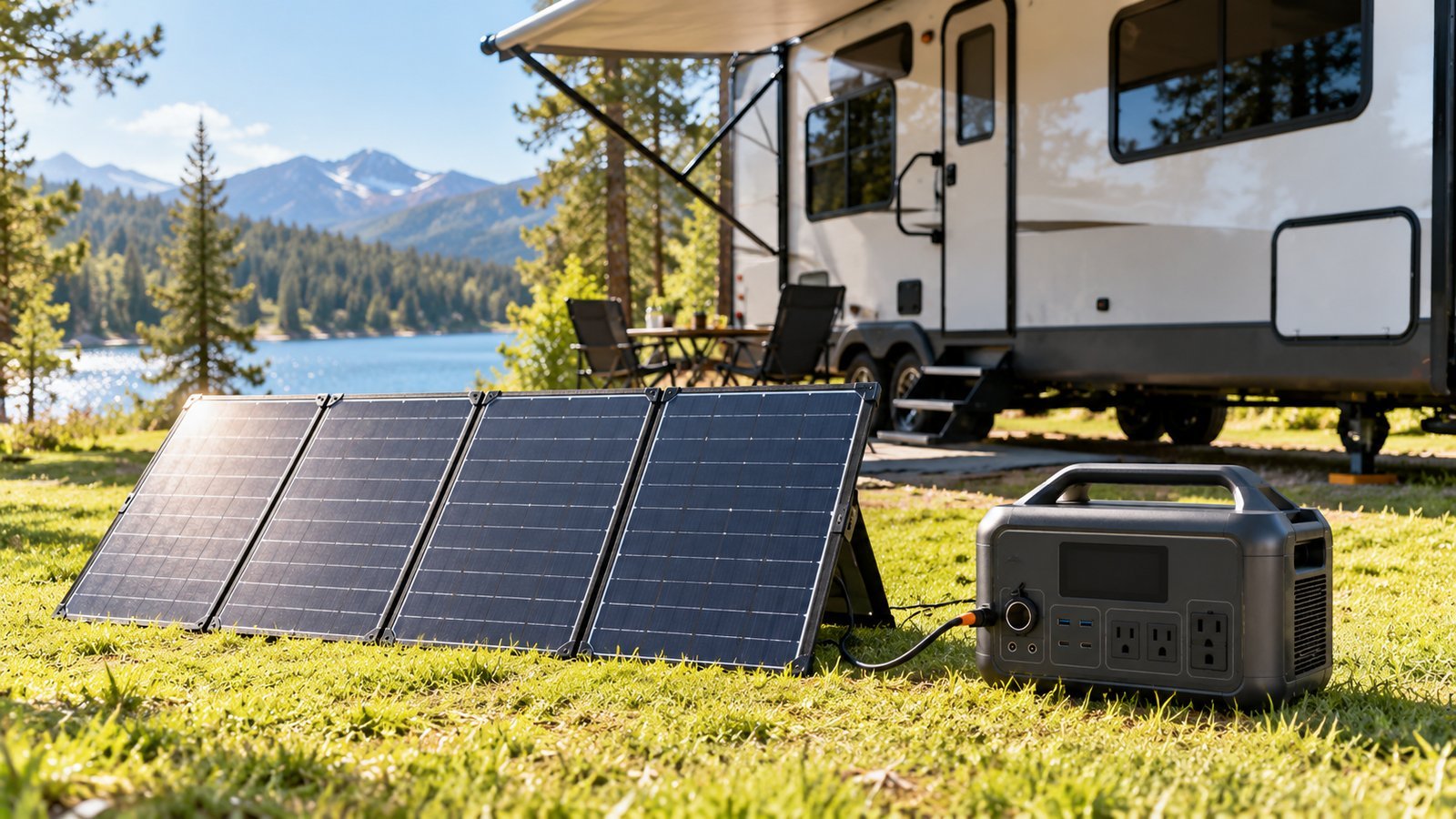
The same kit that backs up an apartment fridge can power a campsite. For camping and RVs, a solar generator handles lights, phones, fans, a CPAP if the manufacturer allows battery use, and a 12-volt cooler, without generator noise or quiet-hours conflicts. Folding solar panels can be moved to follow the sun through the day, which helps a lot under trees.
Off-grid living is a different scale. A cabin or home without grid power usually runs on a permanently installed system with fixed solar panels, a large battery bank and a professionally installed inverter, sized for every day of the year, including the darkest stretch of winter. A portable solar generator can be a useful part of that setup, for example as a backup or for a workshop, but it is not a substitute for a designed off-grid system.
What About Rooftop Solar?
Homeowners with rooftop solar panels are often surprised to lose power in an outage. Most grid-tied systems are designed to shut down when the grid goes down, so they do not send electricity into lines that utility crews may be repairing. Unless the system includes a battery and equipment designed to isolate the home from the grid, it will not keep the lights on.
Systems with home batteries and the right inverter equipment can supply power during an outage, often to selected circuits. Ask the installer how your system behaves when the grid fails, and which circuits it can back up.

Safety and Setup
Solar generators avoid the carbon monoxide danger of fuel generators, but they still need care:
- Follow the power station manual on charging, ventilation and operating temperature
- Keep the power station dry and away from heat sources
- Secure panels so wind cannot lift or tip them
- Route cables where people will not trip over them, especially in the dark
- Do not use a power station that is swollen, leaking or damaged
- Never connect a portable system to home wiring except through equipment installed by a licensed electrician
Ready.gov recommends keeping flashlights, extra batteries and a battery-powered radio as part of any outage plan, and a solar generator works best alongside those basics rather than replacing them. Phones and small electronics can often charge directly from a small panel or a power bank as well; our guide to charging your phone without power lists the options.
Frequently Asked Questions
Can a solar generator power a whole house?
Portable solar generators are sized for essential devices, not whole homes. Powering an entire house typically requires a permanent system with large batteries and professional installation.
How long does it take to charge a power station with solar panels?
Divide the battery’s capacity by the expected solar input after losses. Weather, season and panel angle all change the answer, so expect longer times on cloudy or winter days.
Do solar panels work on cloudy days?
Yes, but output drops, sometimes sharply. Plan with lower figures for cloudy periods and keep the battery charged in advance of storms.
Can I use a solar generator indoors?
The power station can be used indoors because it makes no exhaust. The panels need to be outside in direct sun to produce meaningful power.
Is a solar generator better than a gas generator?
Each has strengths. Solar generators are quiet, safe indoors and fuel-free but limited by battery size and sunlight. Gas generators produce much more power for longer but must run outdoors and need fuel and maintenance.
What battery type is best for a solar generator?
For most people, lithium iron phosphate (LiFePO4) is a strong choice for a solar generator that will be cycled often, because it is generally more thermally stable and has shown long cycle life in testing. Lighter lithium-ion chemistries can suit small units carried often. Lead acid is heavy and has less usable capacity.
Do I need a pure sine wave inverter?
For most home electronics and anything with a motor, pure sine wave output is the safer choice. Many current power stations advertise it, but check the spec sheet.
What does the battery management system do?
It protects the battery by monitoring voltage, current and temperature, and it stops charging or discharging when conditions could damage the cells.
Sources: National Laboratory of the Rockies, formerly NREL (solar resource data and PVWatts calculator), U.S. Department of Energy (Solar Energy Technologies Office, homeowner’s guide to going solar), Ready.gov (Power Outages; Build a Kit), manufacturers’ published specifications and manuals; Preger et al., Sandia National Laboratories, Degradation of Commercial Lithium-Ion Cells as a Function of Chemistry and Cycling Conditions, Journal of The Electrochemical Society (2020); UL Standards and Engagement, UL 2743 Portable Power Packs. Example figures are illustrative, not measurements of specific products.